Counterfeit Detection
A Guide to Spotting Counterfeit Currency

The Banknote Printing Processes
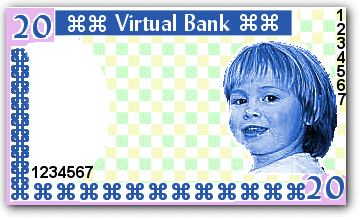 Here is a very simplified "virtual banknote"
Most banknotes employ three types of printing processess
and they are all represented on our virtual note, click and see.
Lithography
Dry offset lithography is generally used for bank note printing. This sounds quite complicated but the principles are quite simple! The image on the printing plates is defined by raised areas, the same principle as a potato cut for potato printing. These raised areas are inked up and instead of being transferred straight to the paper as we would do with potato prints the design is transferred or "offset" to a rubber blanket. The print is then transferred from the blanket to the paper.
Lithography is used for most of the background printing and is the first to be printed.The resulting print is flat crisp and well defined.
If we look at our "virtual note" the litho portion is represented by :-
The image on the printing plates is defined by raised areas, the same principle as a potato cut for potato printing. These raised areas are inked up and instead of being transferred straight to the paper as we would do with potato prints the design is transferred or "offset" to a rubber blanket. The print is then transferred from the blanket to the paper.
Lithography is used for most of the background printing and is the first to be printed.The resulting print is flat crisp and well defined.
If we look at our "virtual note" the litho portion is represented by :-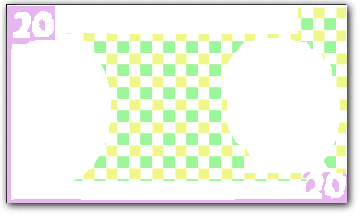 The litho component of the bank note has three colours, yellow, green and purple, and will therefore require three different printing plates
Intaglio
When all the lithographic printing has been completed we move on to intaglio printing. Looking at our virtual note the intaglio is represented by the blue ... the portrait, the borders and the denomination These are generally the area on most notes where intaglio is used. Exceptional detail is capable when printed using intaglio and the printing mechanism produces a very characteristic "raised" feel to the print. Intaglio can be found on both sides of the note but generally more is seen on the front.
Intaglio printing on a large scale is quite unique to banknotes. On a commercial level it is reserved for one-off art prints. The printing plates used in this process have the image area etched into them - that is the image represents the recessed area of the plate ( this is opposite to our potato print concept) The plate is inked up and wiped so that there is ink in the recessed areas only. The ink is then transferred directly from the plate to the paper at a high temperature and pressure.
The printing conditions are such that the paper is sucked into the recesses in the plates and deformed. The ink then sits on top of the paper deformations and hence a tactile effect results from a combination of paper deformation and ink thickness.
Letterpress
Finally we reach the printing process which makes every bank note unique. The letterpress printing process is responsible for putting an individual number onto each and every bank note. Letterpress printing is generally found on the front of the note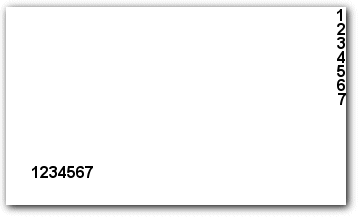
Silk Screen Printing
Silk screen printing is occasionally used to print certain specialised security features on banknotes and is therefore worth a mention. However it is not a widely used process for banknote production.The silk screen printing process is achieved by pushing ink through a screen which has been imaged with a design. The screen looks rather like a stencil, with non image areas having a solid non porous coating and image areas of open screen.